 Jan 24 2026
 Jan 17 2026
 Jan 10 2026
 Jan 03 2026
 Dec 27 2025
 13-26 December 2025
 Dec 06 2025
 Nov 29 2025
 Nov 22 2025
 Nov 15 2025
 Nov 08 2025
 Nov 01 2025
 Oct 25 2025
 Oct 18 2025
 Oct 11 2025
 Oct 04 2025
 Sep 27 2025
 Sep 20 2025
 Sep 13 2025
 Sep 06 2025
 Aug 30 2025
 Aug 23 2025
 Aug 16 2025
 Aug 09 2025
New Scientist covers the latest developments in science and technology that will impact your world. New Scientist employs and commissions the best writers in their fields from all over the world. Our editorial team provide cutting-edge news, award-winning features and reports, written in concise and clear language that puts discoveries and advances in the context of everyday life today and in the future.
What an idea! • Looking back on the best (and worst) ideas of the past 25 years
New Scientist
Back where she belongs
Our demand for water is exceeding supply • A large proportion of the global population faces high water stress – when freshwater demand exceeds supply from rain and snowmelt
World faces era of ‘water bankruptcy’ • Countries have spent beyond their sustainable water budgets, which could have huge economic, social and environmental costs, finds Alec Luhn
River deltas at risk
T. rex took 40 years to become fully grown
Body fat supports your health in surprisingly complex ways
Giving astronauts tardigrade powers could come at a cost
No quantum advantage here • A problem so complex it was thought to require the use of a quantum computer may just have been solved by a conventional supercomputer, reports Karmela Padavic-Callaghan
Climate impacts could cost trillions • We may have underestimated the rate of warming, and its effect on the world economy, as the annual rate of emissions continues to increase, discovers Alec Luhn
Distant ‘little red dot’ galaxies may contain baby black holes
Faint star may be a failed supernova
Woolly rhino genome holds clues to its demise
Earliest known supernova sheds light on first stars
Tiny tweaks may mean a longer life • Getting just a few more minutes of sleep and exercise per day, plus eating an extra half-serving of vegetables, could add a year to your life, finds Carissa Wong
Eating meat could help people reach 100
AI solves historical maths problems • ChatGPT has helped people untangle problems that previously eluded professional mathematicians, potentially changing the entire field, reports Alex Wilkins
You wouldn’t want to use Pompeii’s public baths before the Romans arrived
Long-living sharks seem unaffected by diseased hearts
Changing direction • We thought we could “nudge” people into making the world a better place. We were wrong, say Nick Chater and George Loewenstein
This changes everything • The lonely internet crowd Almost 80 years ago, sociologists identified a new personality type that is particularly sensitive to loneliness. It’s even more relevant today, says Annalee Newitz
Monkey magic
The wildest of rides • An enthralling book reveals how genetics has rewritten the intertwined story of horses and humans, finds Christa Lesté-Lasserre
Breaking the rules • Finding order in what looks like chaos is seductive in science and daily life, but is the price too high? Alex Wilkins explores
New Scientist recommends
The sci-fi column • Fresh fields Peter F. Hamilton’s latest epic, A Hole in the Sky, is set on a troubled ark ship hundreds of years into its voyage, with fantastic plot twists and turns. I’m a big Hamilton fan, but it’s a little too teenage for me, says Emily H. Wilson
Your letters
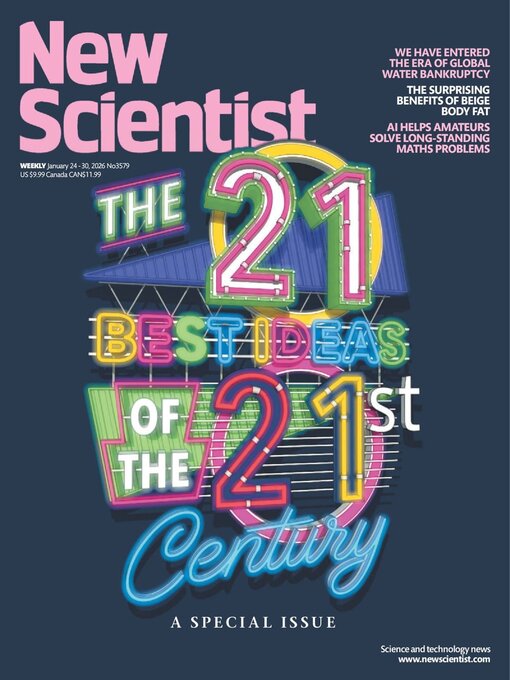
The 21 Best IDEAS of the 21st century • We are now a quarter of the way into this century, and science has already reshaped our understanding of ourselves, the universe and our place within it. But what are the ideas that have helped guide this progress? Over the next 14 pages, discover New Scientist’s pick of the most transformative ideas in science and technology since the turn of the millennium.
X marks the spot • Time it right each...