 March/April 2026
 December/January/February 2026
 October/November 2025
 August/September 2025
 Jul 01 2025
 Jun 01 2025
 May 01 2025
 March/April 2025
 December/January/February 2025
 October/November 2024
 August/September 2024
 Jul 01 2024
 Jun 01 2024
 May 01 2024
 March/April 2024
 December/January/February 2024
 October/November 2023
 August/September 2023
 Jul 01 2023
 Jun 01 2023
 May 01 2023
 March/April 2023
 December/January/February 2023
In-Fisherman is for the avid freshwater angler. Each issue provides detailed instructions and demonstrations on catching, cleaning, and eating your favorite species of fish, and reports on the latest scientific studies concerning fish and habitat conservation. This is the source for finding fishing hotspots, new tackle, effective equipment, and more!
In-Fisherman
Pass Fishing On • The gravel driveway from the county blacktop to our family’s farmhouse covered 500 feet. When the bright yellow school bus dropped me off at the end of the day, I’d collect our family’s mail and shuffle through the grit and gravel, meandering slowly around frost boils while making my way to the house. But on one fateful day, I’m fairly certain I floated up that road.
Bits & Pieces • Blending Fishery Science with Everyday Fishing
ADVENTURES • Feature Travel Tips from In-Fisherman Staff & Friends
STAFF Noteworthy & New • New and Unique Fishing Stuff, as Reviewed by the In-Fisherman Staff
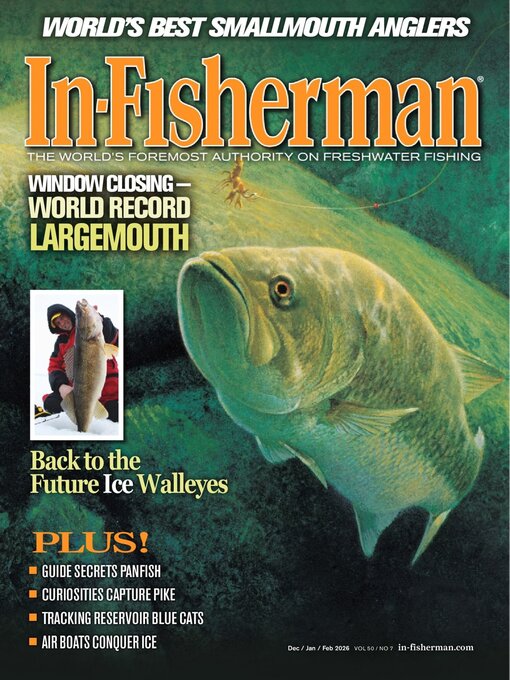
WORLD RECORD Wonderings • We’re at a lull in the production of truly giant bass—not bucket-list double-digit fish, or even a legit 13-pounder to qualify for the Texas Parks & Wildlife Department (TPWD) ShareLunker Program or the Florida Fish & Wildlife Commission’s (FWC) “Legend” status. We’re talking the biggest of the big: upper-teen fish to those closing in on or even surpassing 20 pounds. Sound like a tall order? That’s because it is.
World’s Best Smallmouth Anglers: Nature or Nurture? • How does one become one of the best smallmouth fishermen in the galaxy (assuming Earth is the only planet with smallmouth bass)? Is it by learning from a mentor, or something you’re born with or into? “Into” meaning the environment you’re raised in. In other words, is it nurture or nature?
BACK TO THE FUTURE ICE WALLEYES • Live sonar is making a mark on our sport, but we still have to catch the fish when we get over them, if, indeed, we can, as we now see (literally) just how fishing pressure (and perhaps sonar pulses) change fish attitude, often for the worse, making them move away or stay away—so much so that anglers now are recalculating strategies to intercept walleyes by setting up strategically, minimizing noise, and using old-school sit-and-wait tactics and lure presentations to catch them.
FROM THE PIKE FILES • With a circumpolar distribution across the northern hemisphere, pike have been richly studied in a multitude of waterscapes and world nations across North America, Europe, and Asia. With such a widespread range, ecological importance as an apex predator, and large attainable size, it’s no wonder the species has such a deep and widespread interest among the fishery science community and Esox anglers alike.
Crappies North to South How Guides Roll with the Fall to Winter Transition • The timeframe extending from mid-autumn to early winter presents excellent opportunities to catch crappies galore. Knowing the locations crappies prefer during the Coldwater Period is crucial to consistently catching them—and solving this puzzle requires consideration of variables such as water temperature, clarity, and in certain regions, water levels, along with the waterbody’s habitat options and forage details.
TRACKING COLD WATER BLUE CATS • On a crisp winter morning in the mid-1980s, two fellas stepped into the Southwest (Oklahoma) Fisheries office to ask if we had some scales big enough to weigh their catfish. Everyone gathered outside to witness two of the biggest fish I’d ever seen from freshwater. Richard Hopper and Gerald High, two veteran catmen, had been juglining that cool February day on nearby Lake Lawtonka, and netted two huge blue cats.
MOTV Insider • Featured programming selected by the In-Fisherman staff, streaming now at MyOutdoorTV. Watch...